Automated Powder Coating Line Cost Breakdown and Investment Scope in Indonesia
A transparent engineering guide explaining why turnkey powder coating line prices vary widely in Indonesia, detailing scope options across pretreatment, booths, ovens, conveyors, and return on investment calculation.
Why a single fixed price for an automated line does not exist
One of the most frequent inquiries our engineering department receives is: 'What does a complete automated powder coating line cost in Indonesia?' The only honest engineering answer is that a universal fixed turnkey price does not exist, and any supplier quoting a generic package price without reviewing your engineering specifications is misleading you.
An automated powder coating line is custom-engineered around four physical variables: maximum workpiece envelope (length, width, height, and unit weight); required line speed (governed by daily square meter output targets); substrate metallurgy (which dictates the number and chemistry of chemical pretreatment stages); and the frequency of color changeovers.
A compact line designed to coat small electrical junction boxes at one meter per minute involves fundamentally different equipment sizing, oven cubic capacity, and burner output compared to a high-speed automotive component line running at three point five meters per minute with eight-stage zirconium pretreatment.
- Line cost is dictated by workpiece dimensions, weight, and target throughput speed
- Pretreatment chemistry stages depend on metal substrate and corrosion standards
- Single-color lines require simpler recovery compared to frequent multi-color production
- Beware of generic online catalog prices that omit essential civil, ducting, and safety scopes
Scope Component 1: Chemical pretreatment systems
Surface preparation represents the first major cost module. For factories with limited floor space and moderate budgets, batch immersion dip tanks overhead crane hoists represent an entry-level investment. However, dip tanks require substantial manual labor and drag out large volumes of chemical solution from bath to bath.
For true automated production, a continuous multi-stage spray tunnel is required. Cost drivers here include the number of chemical stages (typically five to seven stages for automotive and architectural specifications), construction metallurgy (stainless steel SS304 or acid-resistant SS316 for chemical tanks versus polypropylene), high-efficiency vertical stainless pumps, and automated chemical dosing systems.
While a stainless spray tunnel requires higher upfront capital expenditure, it drastically cuts operating expenditure (OPEX) by minimizing water consumption through counter-current cascading rinses and reducing chemical drag-out.
Scope Component 2: Spray booth and powder recovery technology
The powder spray booth represents the technological core of the coating line. The primary cost fork sits between cartridge-filter recovery booths and multi-cyclone composite plastic booths.
Cartridge booths constructed from stainless steel carry a lower initial capital cost. However, they are virtually restricted to dedicated single-color production. Cleaning twenty filter cartridges for a color changeover takes hours, resulting in substantial production downtime. If multiple colors are sprayed into one cartridge booth, powder cannot be recycled and must be discarded as waste.
In contrast, quick-color-change booths built from non-conductive plastic sandwich panels paired with high-efficiency multi-cyclone separators and absolute after-filter cartridges require higher initial capital investment. Yet they recover up to ninety-seven percent of oversprayed powder and allow complete color changeovers in under fifteen minutes, delivering rapid payback for facilities running diverse color portfolios.
- Cartridge steel booths: lower CAPEX, ideal for dedicated single-color long production runs
- Plastic composite cyclone booths: higher CAPEX, rapid 15-minute color changeovers
- Multi-cyclone recovery captures 95-97% of oversprayed powder for immediate reuse
- Air knife automated booth floor cleaning systems eliminate manual powder sweeping
Scope Component 3: Electrostatic spray guns and reciprocators
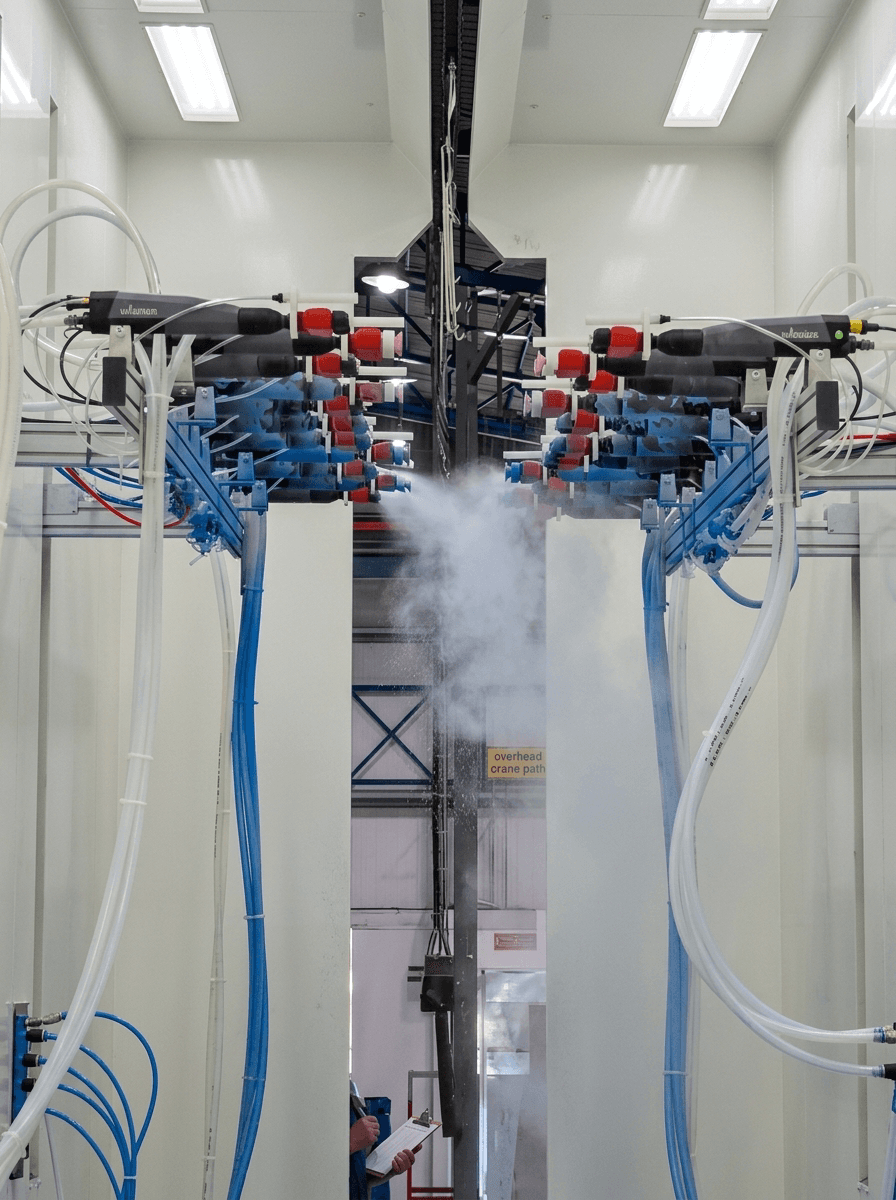
Application equipment pricing depends on the number of automated spray guns and the sophistication of the motion controllers. A typical automated booth incorporates six, eight, ten, or twelve automatic spray guns arranged opposingly on vertical reciprocators.
Electron automated spray guns incorporate advanced high-voltage cascades delivering up to one hundred twenty kilovolts with digital closed-loop current control. This electronics architecture ensures superior powder charging and deep penetration into shielded Faraday cage corners without triggering back-ionization defects.
Investing in optical part-detection light curtains at the booth entrance increases equipment cost marginally while delivering immense powder savings. The sensors map the incoming workpiece profile and communicate with the PLC, firing individual guns only when metal is in front of the nozzle, preventing thousands of kilograms of powder from spraying into empty air between parts.
Scope Component 4: Curing and dry-off convection ovens
Thermal ovens represent both a substantial capital investment and the largest single monthly utility operating cost for an Indonesian coating plant. A continuous tunnel oven must be sized to provide ten to fifteen minutes of holding time at substrate metal temperature (180°C–200°C), accounting for heating up heavy steel masses.
Cost drivers include oven length, structural steel framing, rockwool insulation density and thickness (150mm to 200mm with thermal break construction), and the heating burner system. Modulating industrial gas burners (running on LPG or pipeline CNG) offer the lowest operating fuel cost in Indonesian industrial zones compared to electric heating banks.
Skimping on oven insulation thickness to reduce initial purchase cost is a severe financial error. A poorly insulated oven radiates heat continuously into the factory floor, driving up monthly gas utility bills by millions of rupiah and forcing worker discomfort in tropical plant conditions.
- Tunnel length engineered to ensure true metal temperature soak time at target line speeds
- Insulation thickness of 150mm to 200mm mineral wool with thermal-break exterior panels
- Air curtains at entry and exit vestibules to trap convective heat inside the tunnel
- Modulating LPG or natural gas burners offer far lower operational cost than electric heating
Scope Component 5: Conveyor material handling and plant utilities
The conveyor system must safely support the cumulative weight of thousands of hanging workpieces across hundreds of meters of overhead track. Heavy-duty overhead monorail systems are priced based on track profile, chain link grade, drive caterpillar units, variable speed frequency drives, and high-temperature automatic oilers.
Beyond the equipment itself, plant managers must budget for plant utility and civil infrastructure scopes. These include exhaust ducting penetrating the factory roof, compressed air dryers (producing clean, oil-free, dry air at -40°C dew point), gas piping headers with safety regulators, electrical distribution panels, and industrial wastewater treatment (IPAL) for pretreatment effluent.
A professional integrator provides comprehensive engineering interface drawings so civil and electrical contractors can prepare the site concurrently while machinery is being manufactured, avoiding costly site delays.
The honest ROI framework: calculating payback from real plant savings
Evaluating the financial viability of an automated line must be grounded in your plant's operational data rather than generic claims. Payback is generated across three primary mechanisms: powder material savings, labor consolidation, and the elimination of subcontracting and quality rework costs.
First, automated reciprocators with optical part sensors control coating thickness within tight tolerances (e.g. 60–75 microns), eliminating the massive 100–140 micron over-coating typical of manual fatigue. Second, a continuous line replaces multiple manual sprayers and trolley pushers with streamlined hanging personnel. Third, moving coating in-house eliminates external subcontractor markups, double-handling logistics, and freight transit damage.
By inputting your monthly metal tonnage, current powder purchasing records, and subcontractor invoices into our engineering ROI calculator, most mid-to-large manufacturers in Indonesia find that an automated line delivers full capital amortization within twelve to twenty-four months.
- Material savings: automated reciprocators prevent heavy manual over-coating waste
- Labor optimization: replaces multiple sprayers and trolley pushers with efficient loading
- Quality savings: eliminates client reject claims, rework stripping, and transit denting
- Comprehensive payback typically achieved within 12 to 24 months of full operation
Cost Driver Matrix by Line Module
How engineering specifications and module choices directly impact equipment capital expenditure and long-term operating costs.
| Scope Configuration Options | Primary Capital Cost Drivers | Long-term OPEX Impact | |
|---|---|---|---|
| Chemical Pretreatment | Batch immersion dip tanks vs continuous multi-stage spray tunnel | Number of stages (3-stage iron vs 5 to 7-stage zirconium), SS304/SS316 tank metallurgy, and automated chemical dosing | Spray tunnels save substantial chemical and water rinse volume compared to uncontrolled manual dip drag-out |
| Powder Spray Booth | Stainless steel cartridge booth vs composite plastic booth with multi-cyclone recovery | Booth material (sandwich plastic vs steel), recovery cyclone efficiency, explosion ducting, and automated floor air knives | Composite plastic cyclone booths slash color change times from hours to 15 minutes, cutting lost production hours |
| Electrostatic Guns & Automation | Fixed gun racks vs programmable multi-axis reciprocators with optical contour detection | Number of automatic spray guns (e.g. 6, 8, 12 guns), digital high-voltage cascade quality, and part-height light curtain sensors | Optical gun triggering fires guns only when parts enter the spray zone, preventing massive powder overspray waste |
| Drying & Curing Ovens | Box batch ovens vs continuous overhead tunnel ovens with air seal vestibules | Tunnel length, rockwool insulation thickness (150mm–200mm), and burner modulation technology (LPG/CNG vs electric) | High-density thermal break insulation and modulating gas burners reduce monthly plant fuel consumption substantially |
| Overhead Conveyor System | Lightweight enclosed track vs heavy-duty I-beam monorail vs power-and-free accumulation | Total track length, weight load rating per trolley (e.g. 50kg, 100kg, 250kg), VFD drive units, and high-temp automatic lubrication | Automated continuous transport eliminates shop-floor trolley pushers and reduces transit part collisions |
| PLC Controls & Plant Civil Works | Basic relay controls vs central industrial PLC touchscreen with recipe management | HMI touchscreen size, SCADA network integration, plant exhaust ducting, and industrial wastewater treatment (IPAL) | Recipe management enables instant parameter changes without trial-and-error scrap during shift changeovers |
Questions regarding automated powder coating line costs and budgeting
- Why cannot suppliers quote a single standard price for an automated line?
- Because every line is custom-engineered to match the customer's maximum part size, line speed, daily square meter targets, and chemical pretreatment stages. Quoting a blanket price without part drawings and throughput requirements is technically irresponsible.
- Which equipment module represents the largest share of capital investment?
- The curing and drying ovens, along with the automated spray booth and recovery system, typically represent the largest capital components due to their size, stainless steel/composite construction, combustion burners, and precision electrostatics.
- Is LPG burner heating cheaper to operate than electric heating in Indonesia?
- Yes, significantly. For continuous industrial ovens in Indonesia, modulating LPG or natural gas burners offer substantially lower operating costs per kilowatt-thermal compared to industrial electric heating elements.
- What is the typical return on investment (ROI) timeline for an automated line?
- For factories coating over 500 square meters per day or spending heavily on external subcontracting, capital investment is typically amortized within 12 to 24 months through reduced powder waste, lower labor costs, and eliminated rework.
- Does the system proposal include exhaust ducting, gas piping, and civil works?
- Equipment proposals typically cover all machinery, controls, and commissioning. Exhaust ducting to the roof, external gas supply tanks, and floor foundations are detailed in engineering interface drawings and budgeted as facility utilities.
- How can our plant obtain an accurate, detailed cost proposal?
- Contact PT Solusi Rekatama Makmur with your maximum part dimensions (length, width, height, weight), target production volume per shift, available factory floor dimensions, and electrical/gas utility availability for a custom engineering study.
Request a custom line sizing and cost assessment for your plant
Provide your part drawings and daily production targets to our engineering team. PT Solusi Rekatama Makmur will prepare a transparent equipment sizing proposal and financial ROI model for your facility.