Paint Circulation System Engineering: Sizing, Pressure, and Maintenance in Indonesian Plants
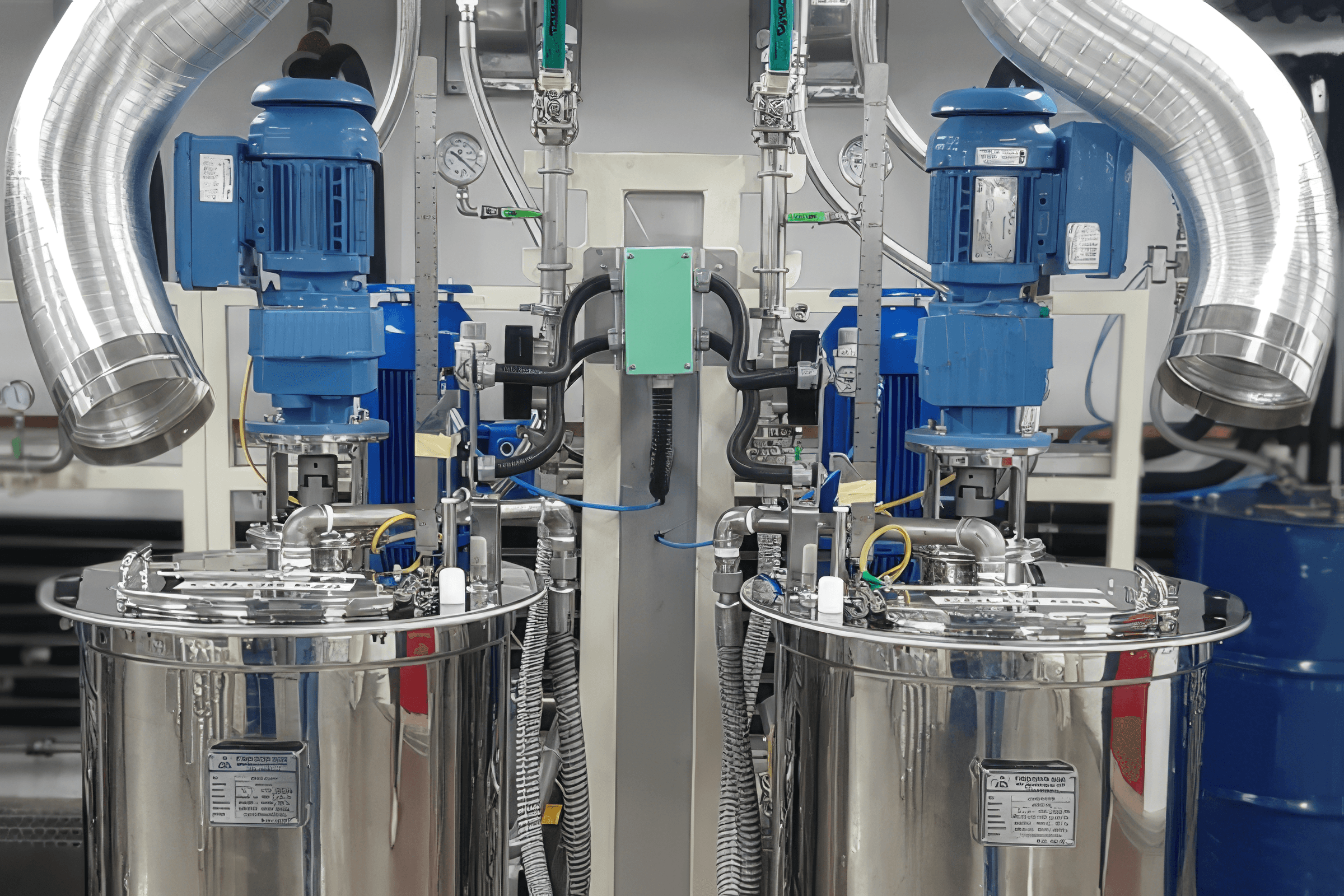
The engineering behind a paint circulation loop: how fluid velocity and pipe size are calculated, how pressure is held steady at every gun drop, how filtration and temperature are managed, and how to read a loop that has started misbehaving.
Sizing a loop starts from velocity, not from pump capacity
The first number in any circulation design is not pump output. It is the fluid velocity that has to be maintained inside the pipe, because that is what keeps pigment in suspension. The benchmark industry standard across automotive and industrial finishing specifications is strictly 40 to 120 FPM (feet per minute), equivalent to approximately 0.2 to 0.6 meters per second. Operating below 40 FPM allows heavier pigments, primers, and metallic flakes to settle along horizontal runs, while operating above 120 FPM generates high shear stress that degrades flake geometry and accelerates pipe wear.
From that velocity and the pipe's internal diameter follows the flow the loop must carry. Add the draw of every gun drop at peak — not average, peak, because the loop has to hold when every booth is spraying at once — and you have the duty the pump actually has to meet. Sizing from average consumption is the most common reason a loop that looks fine on paper starves at its far end during a busy shift.
Pipe diameter then becomes a balancing act in the other direction. Too large, and velocity falls below the 40 FPM settling threshold even though the flow figure looks generous. Too small, and pressure drop along the run grows until the pump has to work hard enough to start shearing the material. Supply and return are not automatically the same size either; return carries whatever is not drawn off, so sizing it by habit rather than by calculation is how return lines end up running too slowly.
- Maintain fluid velocity strictly between 40 and 120 FPM (0.2 to 0.6 m/s) to eliminate pigment settling
- Minimum fluid velocity verified against the paint manufacturer's technical data sheet
- Peak simultaneous draw across all gun drops, not average consumption
- Internal pipe diameter chosen so velocity stays in band at both low and high demand
- Supply and return sized separately from the flow each actually carries
- Turnover rate: how many times the full tank volume passes through the loop per hour
Pressure drop, the furthest drop, and setting the back pressure regulator
Pressure falls along the length of any run, and it falls further through every bend, valve, and filter. The point that governs the design is always the furthest gun drop, because if pressure is right there it can be brought down everywhere closer. Designing from the nearest drop instead is how a plant ends up with the last booth on the line permanently spraying thin.
The back pressure regulator sits at the end of the loop, before the return, and its job is to hold the whole loop at a set pressure regardless of how many guns are drawing. Set it too low and pressure sags whenever several guns open together. Set it too high and the pump works harder than necessary, energy goes up, and shear-sensitive materials start suffering for no gain in finish.
Each gun drop then takes its own fluid regulator off the supply run, so operators can tune their station without moving pressure at anybody else's. During commissioning we set the back pressure regulator first, then each drop in turn, then re-check the furthest one — because setting the near drops changes what the far one sees, and a single pass through the line is not enough.
Filtration: mesh size, position, and a schedule that gets followed
Filtration in a circulation loop does two different jobs, which is why it usually appears in two places. A coarse filter after the pump catches what comes in with fresh material — skin from a drum, agglomerates from a batch that sat too long. A finer filter close to the gun drops catches what the loop itself generates over time.
Mesh selection is a trade rather than a maximum. Finer is not automatically better: a mesh too fine for the material raises pressure drop, blinds off quickly, and in shear-sensitive paints can damage the very metallic flake the finish depends on. Matching mesh to the material and to the atomisation the gun needs is the correct target.
The part that fails most often in practice is not the filter but the schedule. A filter changed by calendar rather than by differential pressure is either changed too early, wasting elements and material, or too late, by which point flow has already dropped and the far end of the loop is being starved. Reading differential pressure across the filter and changing on that reading is a small habit that removes a whole category of intermittent finish defects.
- Coarse filtration after the pump for incoming contamination
- Fine filtration near the gun drops for what the loop generates
- Mesh matched to material and to the atomisation the gun requires
- Change on differential pressure, not on the calendar
- Spare elements stocked on site, since a loop is not run without filtration
Temperature and viscosity in an Indonesian plant
Viscosity moves with temperature, and in an Indonesian plant temperature is not a constant anyone can ignore. Ambient is high to begin with, the paint mix room often sits under a roof that gains heat through the day, and the pump itself puts energy into the fluid every hour it runs. A loop that sprayed correctly at seven in the morning can be spraying thin by mid-afternoon without a single setting having changed.
Operators usually compensate the way that is available to them — a little more solvent — and that correction quietly becomes the standard. Material cost rises, VOC rises, and film build starts drifting away from specification. The defect was never the paint; it was an uncontrolled temperature.
Where the material is sensitive or the tolerance is tight, the answer is to control the fluid temperature rather than the room: a heat exchanger in the loop holds paint within a band regardless of what the shop floor does. Where that is not warranted, at minimum viscosity should be measured at a fixed point in the shift rather than judged by eye, so a trend is visible before it becomes rework.
Colour change and flushing without pouring solvent away
Solvent consumption during colour change is one of the largest recurring costs in a paint shop, and most of it is decided by the layout of the loop rather than by operator discipline. The volume of material trapped between the change point and the gun is what must be pushed out every time, so a long, oversized run costs solvent on every single changeover.
Dead legs make it worse and are worth naming precisely: a dead leg is a blind length of pipe — a capped branch left for a future booth, a valve run that is no longer used, a tee that goes nowhere — where paint sits outside the circulating flow. It does not flush with the rest of the loop, it hardens over months, and it eventually returns to the line as hard particles that show up in the finish. The fix belongs on the piping drawing, not in the cleaning procedure.
Where colours change often, the sequence itself is worth designing: grouping light to dark reduces the number of full flushes, and a documented changeover procedure keeps the solvent volume from drifting upward as different operators develop different habits.
Reading a loop that has started misbehaving
Faults in a circulation system tend to present at the gun, which is why the gun is usually what gets replaced first. Reading the symptom back to the loop saves a lot of parts. A few patterns account for most calls.
Colour that differs between the first booth and the last points at pressure, not at paint: either the back pressure regulator is set low, or the furthest drop was never in band. Nozzles clogging at the start of a shift but not during it points at settling while the line stood — velocity too low, or flow interrupted overnight. A metallic finish that has lost its effect while the batch certificate is unchanged points at shear: a pump running faster than it needs to, or a filter mesh too fine for the flake.
Hard particles appearing suddenly in an otherwise stable system almost always point at a dead leg or a tank that was not cleaned to schedule. And a gradual loss of flow at the far end, with everything else unchanged, is the filter asking to be read rather than the pump failing.
- Colour drift between booths — check loop pressure and the furthest drop first
- Clogging at shift start — velocity or overnight standstill, not the nozzle
- Metallic effect lost with unchanged paint — shear from pump speed or filter mesh
- Sudden hard particles — dead leg, or an overdue tank clean
- Slow loss of flow at the far end — differential pressure across the filter
The maintenance that keeps a loop stable
A circulation loop is not a machine that is either running or broken; it drifts. The maintenance that matters is therefore mostly measurement, and it is cheap compared with the rework it prevents.
Daily, the operator records loop pressure and confirms the guns are reading what they should. Weekly, differential pressure across filtration is read and elements changed on that basis, and agitation is checked on every tank in use. Monthly, the diaphragms or packings in the pump are inspected against hours run, hose is checked for stiffening or swelling at the connections, and the tank interior is inspected where the material is prone to skinning.
Beyond that, keeping the parameters written down is what turns maintenance into engineering. A loop with six months of pressure and viscosity readings lets you see a trend and act before it reaches the finish. A loop with no records leaves you diagnosing from memory, which is where equipment gets replaced that was never the problem.
Technical questions about circulation loops
- What fluid velocity does a paint circulation loop need?
- The industry benchmark for industrial paint circulation systems is 40 to 120 FPM (feet per minute), or approximately 0.2 to 0.6 m/s. Velocity must stay above 40 FPM to prevent heavier pigments, primers, and metallic flakes from dropping out of suspension in horizontal pipe runs, while staying below 120 FPM to avoid fluid shear degradation and pipe erosion. Exact thresholds are confirmed against the paint manufacturer's data sheet.
- How often should filtration elements be changed?
- On differential pressure rather than on the calendar. Reading pressure either side of the filter tells you when the element is genuinely loading up; changing by date either wastes elements or lets flow fall away before anyone notices. Where the material is consistent, those readings settle into a predictable interval that can then be scheduled with confidence.
- Why does a metallic finish lose its effect when the paint has not changed?
- Usually shear. The aluminium flake that produces the metallic effect can fracture or reorient if the paint is worked too hard, and the two common causes are a pump running faster than the loop requires and a filter mesh finer than the material tolerates. The chemistry is unchanged, which is why the batch certificate looks fine while the finish does not.
- What is a dead leg, and why does it matter months later?
- A dead leg is a blind length of pipe outside the circulating flow — a capped branch, an abandoned valve run, a tee going nowhere. Paint sitting there does not flush with the rest of the loop, so it settles and hardens over time and eventually releases hard particles back into the line. It is prevented at the piping design stage; once installed it is difficult to cure with cleaning alone.
- Can loop layout reduce solvent used during colour change?
- Yes, and it is usually the larger factor. The volume of material between the change point and the gun has to be pushed out at every changeover, so an oversized or unnecessarily long run costs solvent every single time. Shortening that path, removing dead legs, and sequencing colours light to dark together cut solvent far more than tightening operator discipline alone.
- What has to change if the plant switches to waterborne paint?
- Every wetted part needs material suitable for waterborne, generally stainless steel, because waterborne is corrosive to some metals. Temperature control and cleaning procedure carry more weight, since waterborne is more sensitive to heat and to microbial growth. The electrostatic application equipment differs as well, because waterborne paint conducts and therefore needs different isolation.
Have your loop reviewed by our fluid engineers
Send us your paint data, the number of gun drops, and the run lengths, and our engineering team will tell you where the loop is likely to be limiting you. We reply within 2 business hours.