How to Build an Automated Powder Coating Line: Engineering Guide for Indonesian Plants
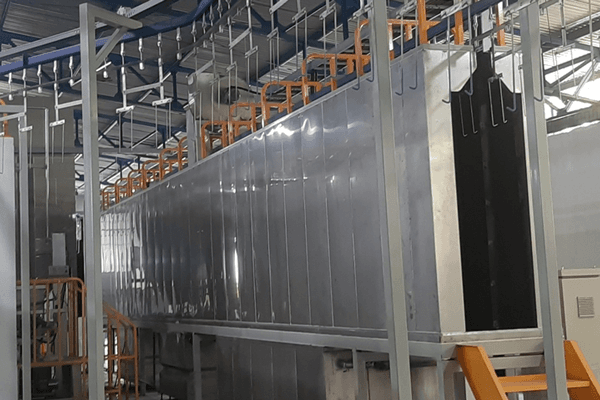
The complete engineering workflow to design and install an automated continuous powder coating line in an Indonesian factory — from chemical bath balancing to curing profiles and continuous conveyor grounding.
Stage 1: Chemical pretreatment that dictates coating adhesion
Over eighty percent of finish failures in powder coating — delamination, blistering, and corrosion creeping under the film — originate in the pretreatment stage, not at the spray gun. In Indonesian manufacturing environments where humidity is consistently high and metal substrates often arrive with heavy drawing oils, cutting fluids, or mill scale, surface preparation is the foundation of the entire coating line.
Selecting between batch immersion tanks and a continuous multi-stage spray tunnel depends on throughput and part geometry. For continuous automated lines, an automated tunnel spray system ensures every surface receives identical chemical impingement. The typical process sequence includes hot alkaline degreasing, clean city water rinse, surface conditioning or conversion coating, followed by a final demineralized water rinse.
Conversion coating chemistry has transitioned significantly from heavy zinc and iron phosphating to zirconium and nano-ceramic conversion systems. Zirconium generates virtually zero sludge, operates at lower bath temperatures, and complies with stringent environmental standards while providing equal or superior salt-spray corrosion resistance. The final rinse must use demineralized water with electrical conductivity maintained strictly below twenty microSiemens per centimeter to eliminate ionic salt residues that cause osmotic blistering.
- Hot alkaline degreasing to dissolve drawing oils and pressing lubricants
- Multi-stage counter-current water rinses to prevent chemical carryover
- Zirconium or nano-ceramic conversion coating for superior adhesion and zero sludge
- Final demineralized water rinse with conductivity below 20 microSiemens
- Automated chemical dosing pumps linked to bath conductivity sensors
Stage 2: Dry-off moisture oven before powder application
Once metal components emerge from the final wet chemical rinse, all surface water and trapped moisture inside hems, spot-welded joints, and cavities must be completely evaporated before the part reaches the powder booth. Powder coating over moisture causes catastrophic pinholing, bubbling, and adhesion failure during the curing phase.
The dry-off oven operates at temperatures between one hundred ten and one hundred thirty degrees Celsius, utilizing high-velocity convective airflow to sweep away evaporated moisture. Convection blowers must be arranged to direct heated air into internal corners and lower drainage points where rinse water pools.
A cooling zone immediately following the dry-off oven is essential. Parts leaving the dry-off oven at over one hundred degrees must cool down to below forty-five degrees Celsius before entering the powder spray zone. Applying electrostatic powder onto a hot substrate causes pre-melting of powder particles before electrostatic charging can establish a uniform film, leading to severe orange peel and clumping.
- Operating temperature between 110°C and 130°C to flash off all residual moisture
- High-velocity air circulation directed at pockets, hems, and weep holes
- Sufficient travel time or forced ambient cooling zone after the dry-off oven
- Substrate temperature verified below 45°C prior to electrostatic powder spray
Stage 3: Spray booth, reciprocator automation, and cyclone recovery
The powder spray booth is the heart of the application process. In automated lines, booth geometry, material construction, and airflow containment determine both transfer efficiency and color change speed. Modern installations utilize non-conductive plastic or sandwich composite sandwich walls rather than stainless steel, preventing powder from adhering to booth walls and speeding up cleaning.
Air face velocity through open conveyor entrance and exit openings must be engineered precisely between zero point four and zero point five meters per second. If airflow velocity is too low, fine powder particles drift out into the factory floor. If airflow velocity is too high, it disrupts the electrostatic cloud, blowing powder off parts before it can adhere.
Automated application is handled by vertical reciprocators carrying multiple Electron automatic spray guns. Gun triggering is linked to optical detection light curtains that measure workpiece height and profile at the booth entrance, turning individual guns on only when metal is present. For lines handling multiple colors, a multi-cyclone recovery system recovers up to ninety-seven percent of oversprayed powder while allowing rapid color changes in under fifteen minutes.
- Composite plastic booth structure to eliminate powder attraction to walls
- Engineered face velocity of 0.4 to 0.5 m/s across conveyor openings
- Vertical reciprocators with adjustable stroke, frequency, and offset positioning
- Optical light curtains for profile detection and automated gun triggering
- High-efficiency multi-cyclone separator with absolute cartridge after-filtration
Stage 4: Curing oven and substrate metal temperature profiling
Powder coating curing is a thermal cross-linking reaction governed by substrate metal temperature, not simply the surrounding air temperature inside the oven. A standard polyester or epoxy-polyester architectural powder typically requires holding the metal at one hundred eighty to two hundred degrees Celsius for ten to fifteen minutes.
The engineering difference between light-gauge sheet metal and heavy structural profiles is pronounced: a three-millimeter bracket may reach target temperature in five minutes, whereas an eight-millimeter casting requires fifteen minutes just to heat up before cross-linking soak time begins. Continuous ovens are designed with heated air curtains at the entry and exit vestibules to prevent heat escape into the plant.
Insulation thickness of one hundred fifty to two hundred millimeters of high-density mineral wool is mandatory to minimize thermal losses. Direct-fired modulating LPG or natural gas burners offer the highest energy efficiency for Indonesian industrial plants. Curing quality must be validated by running a multi-channel thermocouple datalogger directly through the oven attached to actual customer parts.
- Cross-linking requirement: 180°C to 200°C substrate temperature for 10-15 minutes
- Air curtains at oven entry and exit vestibules to contain hot air
- 150mm to 200mm high-density mineral wool insulation with thermal break framing
- Modulating LPG or CNG burners with proportional temperature controllers
- Routine verification using calibrated traveling oven dataloggers
Stage 5: Overhead conveyor, hanger jigs, and critical grounding
Material transport through the line is managed by an overhead conveyor system — either a heavy-duty continuous monorail or an intelligent power-and-free system with accumulation zones. The conveyor speed must be continuously variable via variable frequency drives (VFD) to balance line throughput against chemical dwell times and oven curing cycles.
Part hanging jigs and hooks represent the single most neglected aspect of powder coating operations in Indonesia. Electrostatic powder attraction depends entirely on grounding: charged powder particles seek ground through the grounded workpiece. Grounding resistance measured between the workpiece and earth ground must remain strictly below one Megaohm.
If hooks accumulate layers of baked powder, electrical resistance skyrockets into gigaohms. When grounding is lost, transfer efficiency collapses, the Faraday cage effect worsens in corners, and accumulated charge on the part sparks back-ionization, destroying finish smoothness. Automated line design must incorporate a scheduled mechanical or chemical hook stripping procedure.
- Overhead monorail or power-and-free conveyor with variable frequency drive
- Continuous conveyor lubrication system rated for 220°C oven operating environments
- Jig geometry designed for maximum part density, drainage, and zero powder trap pockets
- Grounding resistance strictly verified below 1 Megaohm from part to earth ground
- Scheduled thermal, mechanical, or chemical stripping protocol for all hanging hooks
Stage 6: Central PLC automation, powder feed center, and safety
A modern automated powder coating line operates as a synchronized integrated system through a central Programmable Logic Controller (PLC) with an intuitive touchscreen Human-Machine Interface (HMI). The PLC monitors and interlocks all subsystems: line speed, chemical bath temperatures, pump flows, exhaust fan differentials, burner flame safeguards, and reciprocator stroke profiles.
Powder management is centralized in an automated powder feed center. Fresh powder from original boxes is pumped directly into fluidizing hoppers, combined with recovered powder from the cyclone, and passed through an ultrasonic vibrating sieve to eliminate agglomerates and contaminants before reaching the gun injectors.
Safety interlocks are critical in powder coating environments. Because airborne organic powder clouds are combustible, the booth exhaust ventilation must be interlocked with the spray equipment — if exhaust airflow drops below threshold, powder guns are instantly disabled. The installation must also feature infrared optical flame detectors, explosion venting panels on the cyclone and afterfilter, and emergency stops throughout the line.
- Central industrial PLC with recipe management for diverse part geometries
- Automated powder feed center with ultrasonic sieving and fresh powder top-up
- Exhaust ventilation interlock preventing gun activation without airflow
- Infrared optical flame detection and rapid fire suppression interlocks
- Explosion relief venting compliant with NFPA and international safety standards
Technical questions about building an automated powder coating line
- What is the most critical stage when designing an automated powder coating line?
- Chemical pretreatment is the most critical foundation. Over eighty percent of paint flaking and corrosion failures stem from improper surface degreasing or inadequate demineralized rinsing. No matter how advanced the spray guns or ovens are, poor pretreatment will cause coating failure.
- What is the maximum electrical grounding resistance allowed for part jigs?
- Electrical resistance between the workpiece and earth ground must remain strictly below one Megaohm (1 MΩ). Higher resistance prevents electrostatic charge dissipation, drastically lowering transfer efficiency and triggering severe back-ionization defects.
- When should a plant choose a cyclone recovery system over a cartridge booth?
- A cyclone recovery system is the correct choice whenever a factory sprays multiple colors and needs frequent color changeovers. A cyclone allows reclaiming up to 97% of oversprayed powder and cleans down in 10-15 minutes, whereas cartridge booths require lengthy filter cleanings and are best suited for single-color production.
- Why does substrate metal temperature differ from oven air temperature?
- Oven air temperature heats up rapidly, but thick steel substrates require substantial thermal energy and time to reach the required cross-linking temperature. Powder curing requires 180°C to 200°C held on the metal itself for 10-15 minutes, which must be verified with traveling thermocouple dataloggers.
- What conveyor speed is standard for industrial powder coating lines in Indonesia?
- Conveyor speeds typically range between 1.0 and 3.5 meters per minute, depending on part size, pretreatment tunnel length, and oven volume. The speed is dialed in to satisfy the required chemical contact times and thermal curing curves for the heaviest part.
- How much factory floor space is required to install a complete automated line?
- A compact continuous automated powder coating line typically requires a footprint of at least 400 to 800 square meters, with ceiling heights of 4.5 to 6 meters. Exact layout depends on whether the line is arranged in an inline, U-shape, or loop configuration.
Plan your automated powder coating line with our engineering team
Send our engineering team your part dimensions, daily throughput targets, and factory layout. We will prepare an engineering sizing study and technical line layout for your facility.