Robotics
Industrial Robot System Integrator for Factories in Indonesia
PT Solusi Rekatama Makmur is an industrial robot system integrator in Indonesia and Yaskawa's authorized distributor since 2009. We design and build robot cells for handling, assembly, and sealing or dispensing — complete with grippers and end effectors, jigs, conveyor interfaces, control panels, safety circuits, installation, commissioning, and operator training.
We work from our technical centre at MM2100 Cibitung, Bekasi, with head office in Jakarta and a branch in Surabaya. If you are weighing up automating a station but are not yet sure which robot or what the cell should look like, we start from a feasibility study. Reach us on WhatsApp (opens in a new tab) or at sales@solusirm.com.
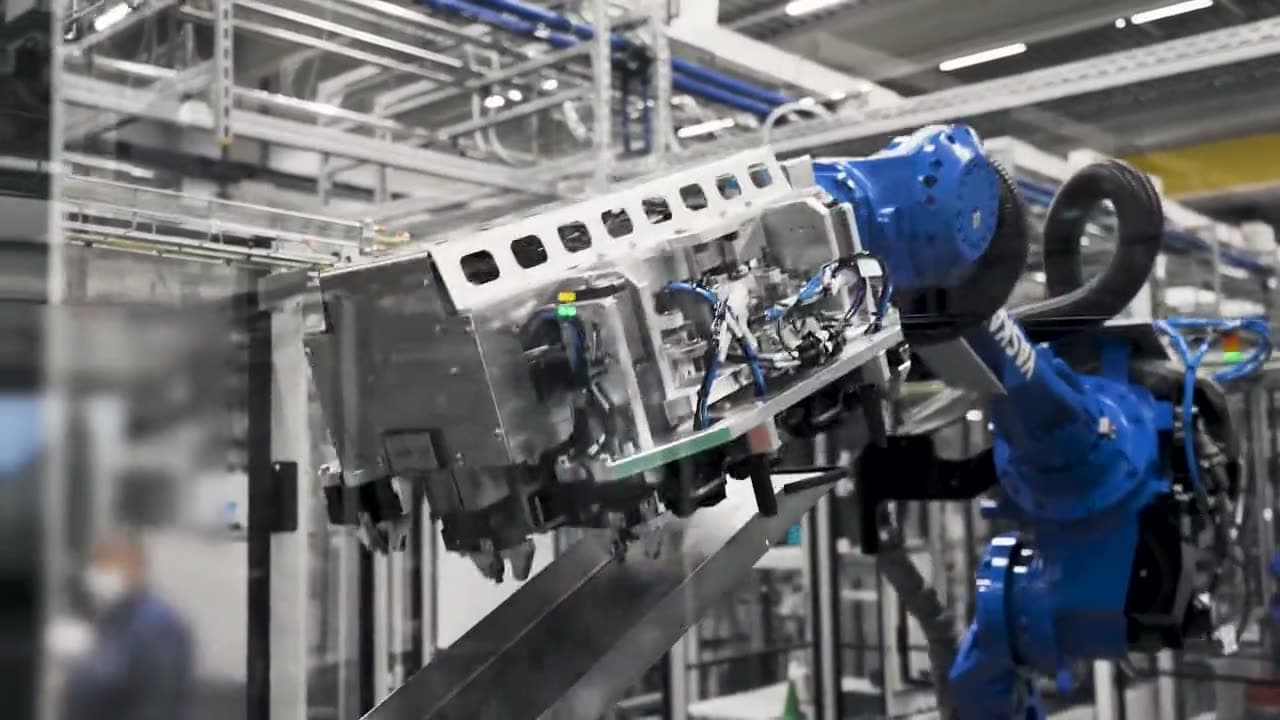
What we bring to an automation project
- Authorized Yaskawa Motoman distributor and system integrator in Indonesia since 2009
- PT Solusi Rekatama Makmur was established in 2002, working in industrial production equipment and systems
- 500+ completed projects across automotive, manufacturing, and general industry
- ISO 9001:2015 and SMK3 certified
- Robotics training centre and sealing demo lab at MM2100 Cibitung, Bekasi for feasibility trials and training
- Experience in sealing and dispensing, not only handling — two disciplines that demand different kinds of precision
- Spare parts and consumables held at Cibitung with a 24/7 service response commitment
What a system integrator actually does
A robot bought on its own is an arm that can move. What makes it produce anything is everything around it: the gripper at the end of the arm, the jig the part sits in, the sensor that says a part has arrived, the conveyor bringing it in and out, the guarding and interlocks that keep people safe, and the program that ties all of it into one sequence.
The integrator's job is to design and join all of that into a single station that can be handed over, run by your team, and audited. What decides whether it succeeds is rarely the robot; it is the small decisions around it — how the part is positioned so it arrives the same way every time, what happens when it arrives crooked, and how an operator stops the process without wrecking the cycle.
That is why our first conversation is almost never about robot brands. What we ask first is what the part looks like, how many seconds a cycle has to finish in, and what has been stopping that station most often until now.
The three kinds of cell we build most often
Automation needs in Indonesian plants usually fall into one of three groups, and each asks something different of the cell design.
First, handling: moving parts between machines, loading and unloading a press or CNC, stacking parts onto a pallet. Here payload, reach, and speed decide the robot, along with a gripper that suits the part surface.
Second, assembly: placing components into defined positions, often to tight tolerances. Here repeatability and how the part is presented to the robot matter far more than raw speed.
Third, sealing and dispensing: laying a clean, consistent bead of material onto a part. This sits closest to our fluid handling background, because the result depends on the robot and the material supply together — pressure, temperature, and flow stability all shape the bead.
- Machine tending: loading and unloading presses, CNC, moulding, or test machines
- Palletizing and arranging parts ahead of packing
- Assembly and component placement at repeatable positions
- Sealing and dispensing adhesive or sealant on bodies and components
- Material transfer between stations within one line
- Inspection stations that need the part held in a particular position
The Yaskawa robots we use outside the paint booth
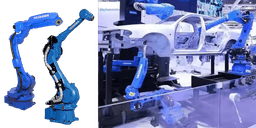
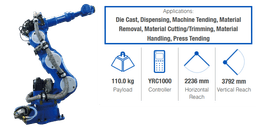
For handling, assembly, and sealing we use the GP family. Selection starts from three numbers that have to be worked out together: the weight actually held at the end of the arm including the gripper, the furthest reach that must be achieved, and the cycle time being chased.
The number most often left out is the gripper's own weight. An 8 kg part on a 12 kg gripper means the robot handles 20 kg, not 8 kg, and that mistake usually surfaces only after the robot has been ordered.
For large parts or working areas full of obstructions, a seven-axis robot gives freedom of movement a six-axis arm cannot match: the arm can fold around an obstacle and still reach the same position. It often rescues a project where automation has to fit into a plant layout nobody can change.
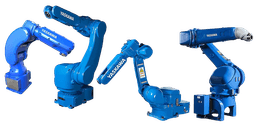
- GP Series — Motoman handling and assembly robots for machine tending, palletizing, and transferring parts between stations
- GP Series 7-Axis — seven-axis robots for large parts and obstructed work envelopes, with more freedom of movement
- MPX Series — explosion-proof robots for coating and dispensing stations that sit inside a hazardous area
Safety is not the last job on the list
The safety circuit is often treated as something fitted at the end so the cell passes inspection. In our experience that order is expensive, because safety decisions determine the physical shape of the cell: where the guarding stands, which side the operator loads from, how far the robot may reach, and how parts enter without opening the hazardous area.
We put it on the table at the layout stage. What needs agreeing early includes who may enter the robot area and by what means, how the cell is stopped in an emergency without destroying the part in progress, and how a technician performs maintenance without shutting down the whole line.
Our SMK3 certification is not only a document. Installation work in a plant that is still producing carries its own risks, and our team works to the same procedures we would ask of a customer's plant.
- Guarding, light curtains, or area scanners chosen from how the operator interacts with the cell
- Access door interlocks and lock-out procedures for maintenance
- Emergency stops reachable from where the operator stands, not only from the panel
- Robot envelope limiting so its reach cannot cross the cell boundary
- A safe restart sequence after the cell has been stopped
When your part has never been held by a robot
The hardest question to answer on paper is whether a given part can be gripped, positioned, or sealed to a consistent result. Flexible parts, easily marked surfaces, or geometry with no clear reference point can all defeat a cell that looks perfect on a drawing.
That is what the demo lab at MM2100 Cibitung is for. Your parts can be tried there with the gripper or applicator we propose, and the result becomes the basis for a decision before anything is bought. If the way the part is held needs to change, this is the stage to find out.
Lab trials are part of technical evaluation. We do not run them as production, and the result is not finished goods to be shipped back.
Buying a robot yourself versus handing over a cell
Some plants consider buying the robot and assembling the cell with an internal team. That can work under the right conditions. This table sets out what differs, so the decision is made deliberately.
| Buy the robot, build it yourself | One cell through an integrator | |
|---|---|---|
| Robot selection | From catalogue specifications | Verified by reach study and payload including the gripper |
| Gripper and jig | Sourced or built separately | Designed with the cell and tested on your parts |
| Accountability if the cell misses target | Spread across several parties | One party for the whole cell |
| Safety circuit | Often added after the layout is fixed | Settled at the layout stage |
| Time to production | Depends on internal team availability | Scheduled as a project with defined stages |
| Your team's capability afterwards | Grows from its own experience | Built through training and handover documentation |
| Best suited to | Plants with an established internal automation team | A first station, or a cell with a binding output target |
How a robot cell project runs
Plant visit and station survey
We look at the station to be automated and record part dimensions and weights, the target cycle time, the surrounding layout, and available utilities. This stage often reveals that what needs fixing first is not the robot but how parts arrive at the station.
Feasibility study and part trials at the demo lab
Your parts are tried with the proposed gripper or applicator, and robot motion is simulated against the real layout to confirm reach, cycle time, and clearances stand up.
Cell design and a quotation broken out by section
We lay out the cell, select the robot, design the gripper and jig, define the control panel scope, and set the safety concept. The quotation is itemised so you can see what is mandatory and what can follow later.
Fabrication, installation, and integration
Grippers, jigs, and panels are built and tested before shipment. On site the cell is installed and tied into the conveyor and neighbouring machines in a sequence that disturbs production as little as possible.
Commissioning and proving the cycle time
The cell runs with real parts, the safety circuit is proven point by point, and cycle time is verified against the agreed target before handover.
Training and documentation handover
Your operators and maintenance staff are trained on operation, editing programs, handling alarms, and routine maintenance, with cell documentation your team can work from later on its own.
Support once the cell is running
Spare parts and consumables are held at Cibitung with a 24/7 response commitment. We also help you draw up the list of components worth stocking yourself, consumables above all.
We build the station; we are not a production service
To say it plainly up front: PT Solusi Rekatama Makmur is an equipment supplier and system integrator, not a production or coating service. We do not take in parts to be machined, coated, or assembled at our premises.
What we deliver is production capability standing inside your own plant — a robot cell you own, you operate, and your team maintains. If what you need is to send work out to somebody else, you are looking for a coating service, a job shop, or a subcontractor rather than an integrator.
Part trials at the Cibitung demo lab are part of technical evaluation before a purchase, and we do not run them as a production service.
Frequently asked questions about industrial robot integration
- What minimum production volume makes a robot worthwhile?
- There is no single number, because what decides it is not volume alone but how repetitive the work is and how expensive a mistake is. A moderate-volume station with a high injury risk or tight tolerances is often a better candidate than a high-volume one whose parts keep changing. We help work it out with your own station data.
- Can a robot be added to a line that is already running?
- Yes, and that is most of what we do. What needs discussing early is the space available, the tie-in points to the conveyor and neighbouring machines, and the shutdown schedule. We plan the work sequence with your maintenance team so production is disturbed as little as possible.
- Who makes the gripper and the jig?
- We design them as part of the cell, because the gripper and jig decide more than anything else whether the cell runs consistently. If your part has an awkward character — flexible, easily marked, or without a clear reference point — we trial it at the Cibitung demo lab before the design is locked.
- Does our team need to know how to program a robot?
- Not for daily operation, since programs are selected from the HMI. But we recommend having at least one or two people who can edit and write programs, so a small change to a part does not have to wait on us. That capability is what the training at Cibitung or at your plant is for.
- What is the difference between a handling robot and a painting robot?
- A painting robot is built to work inside a hazardous area: its body is held at positive pressure with clean air and it is certified explosion-proof. Handling robots such as the GP series are not built for that, so they belong outside the hazardous area. If your station sits inside a paint booth, the robot for it is a painting robot.
- Does PT Solusi Rekatama Makmur take in coating or assembly work?
- No. We design, install, and commission robot cells inside customer plants, and we do not receive parts to be worked on at our premises. If your need is to send work out, you are looking for a coating service, a job shop, or a subcontractor.
- What support follows handover of the cell?
- Spare parts and consumables are held at Cibitung and our service team works to a 24/7 response commitment for lines in production. At handover you receive the cell documentation along with the list of components worth stocking yourself.
Related reading
- Designing a Robotic Assembly Line: A Technical Guide for Plants in IndonesiaMost disappointing robot cells do not fail because the robot was not good enough. They fail on one number calculated wrongly at the start: a payload that forgot the gripper, a reach nobody verified, or a cycle time never broken down move by move. This guide takes those technical decisions one at a time.
- Robotic Painting versus Manual Spraying: The Cost Comparison for Plants in IndonesiaThe question is nearly always the same: how long before a painting robot pays for itself. That answer cannot be quoted from a brochure, because the number is built out of your own plant's data. This guide breaks the comparison into parts you can fill in with your own figures.
Work out which station is worth automating first
Tell us the station you want to automate, what the part looks like, and the cycle time you need to hit. We start from a feasibility study and part trials at the Cibitung demo lab, and we reply within 2 business hours.