Powder Coating
Automated Powder Coating Systems for Industry in Indonesia
PT Solusi Rekatama Makmur supplies and integrates automated powder coating systems in Indonesia, and is the exclusive Electron distributor for the Indonesian market. We design, supply, install, and commission powder coating lines for factories — from booths and guns through recovery systems, curing ovens, conveyors, and control panels.
We work from our technical center at MM2100 Cibitung, Bekasi, with a head office in Jakarta and a branch in Surabaya. Whether you are planning a new line, adding capacity, or replacing a manual process with an automated one, our engineering team can start with a site survey and layout. Reach us on WhatsApp (opens in a new tab) or at sales@solusirm.com.
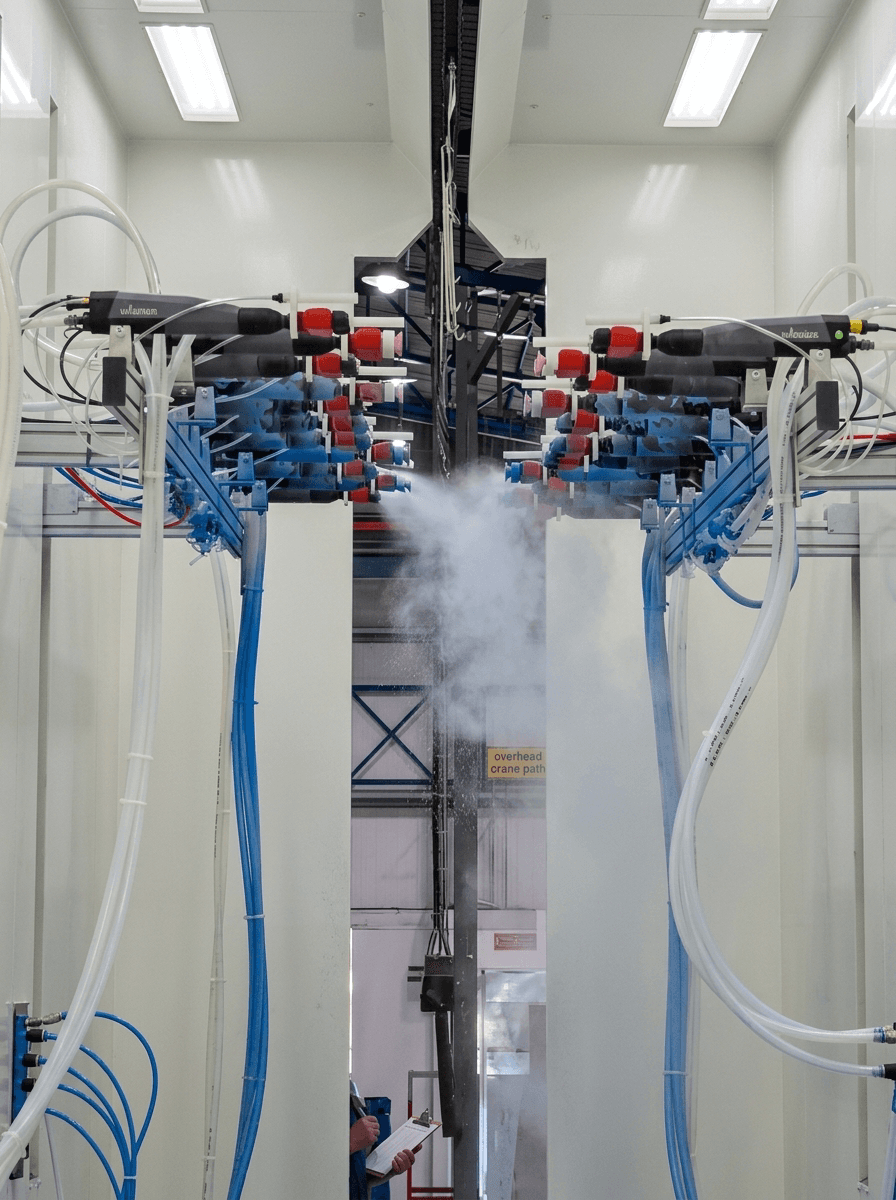
Why factories in Indonesia work with us
- Established in 2002 — over two decades delivering industrial systems in Indonesia
- 500+ completed projects across manufacturing and automotive sectors
- Exclusive Electron distributor for Indonesia — not an intermediate reseller
- ISO 9001:2015 and SMK3 certified
- Technical center and demo lab at MM2100 Cibitung, Bekasi — see the equipment run before you commit
- Local spare parts warehouse, so routine replacements do not wait on an import
- Service team with 24/7 response commitment for running lines
What an automated powder coating line is made of
An automated powder coating line is not a single machine but a sequence of processes that has to stay in balance. When one stage is mismatched to the next, it shows up immediately in coating quality and in powder consumption. This is the sequence we design for factories in Indonesia:
Each stage carries consequences into the next. Inadequate pretreatment appears as poor adhesion after curing, and no amount of extra powder will fix it. That is why we start from your parts and production volume rather than from a catalogue.
- Pretreatment — cleaning and conversion coating so that powder adheres properly
- Drying oven — removes residual moisture before parts reach the powder area
- Powder booth — application enclosure with airflow control so overspray stays contained
- Guns and reciprocators — automated application with consistent pattern and distance
- Recovery system — captures overspray for reuse, the single biggest lever on material cost
- Curing oven — bakes the powder into an even, fully cured film
- Conveyor — links every stage at a speed matched to each stage's process time
- Control panel — temperature, conveyor speed, and gun parameters managed from one point
Why Electron for powder application
As the exclusive Electron distributor in Indonesia, what we offer is not a set of loose units but a range engineered to work together. That matters when you need to add capacity later: components can be added without replacing the control system you already have.
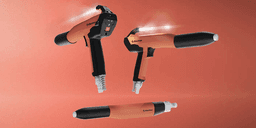
The 120kV technology in Electron guns improves transfer efficiency, particularly on complex parts where the Faraday cage effect is usually the problem — internal corners, recesses, and shielded areas. Powder that actually lands on the part rather than into the booth is a difference you feel in monthly operating cost.
Because we are the authorised distributor, warranty, spare parts, and technical support come through official channels. For equipment running a production line every day, that is not an administrative detail — it determines how long your line is down when a component needs replacing.
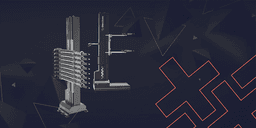
The line is designed around your parts, not the other way round
No single line configuration suits every factory. Part size and weight determine the conveyor and hangers. Production volume determines oven length and line speed. The number of colours you run determines whether colour change needs to be fast or can be scheduled per batch. Building height and existing utility positions are often the constraint that decides the final layout.
That is why the first step is always a survey, not a quotation. We need to know what will be coated, the target output per day, the available electrical and gas supply, and the space you can dedicate. Only then can a configuration be costed that makes sense both technically and commercially.
This approach is also what lets us say early on when your requirement does not yet justify a fully automated line. A properly designed semi-automatic system often returns more than an automated line whose capacity is never fully used.
What drives the cost of a powder coating line
Cost comes up in almost every first conversation, and the honest answer is that it depends on scope. Figures circulating online are usually coating service rates per kilogram rather than system prices, so the two cannot be compared. What we can explain upfront is which factors move the cost, so you can judge any quotation on reasonable terms.
The largest factor is usually oven length and type, because that governs energy consumption for years ahead rather than just the purchase price. Then the level of automation, the number of colours to be handled, and whether pretreatment is in scope or already exists. Building condition matters too — a factory needing foundation reinforcement or an electrical capacity upgrade carries site preparation costs that are not trivial.
What is often forgotten is the operating cost once the line runs: powder consumption, oven energy, and routine component replacement. A good recovery system and guns with high transfer efficiency do raise the initial investment, but both reduce powder cost every month across the life of the line. At high production volumes that difference usually matters more than the difference in equipment purchase price.
- Curing oven length, type, and heat source
- Level of automation — manual, reciprocator, or robotic
- Whether pretreatment is in scope or already available
- Number of colours and how quickly colour change must happen
- Conveyor length and layout complexity
- Site preparation: foundations, electrical capacity, gas, ventilation
- Long-run operating cost: powder, energy, and spare parts
Support once the line is running
A powder coating line is a production asset used every day, so the real value of a system shows after several years of operation. We hold Electron spare parts at our Cibitung warehouse so routine replacements do not wait on an overseas shipment.
Alongside spare parts we provide operator training, support during colour changes and parameter adjustment, and scheduled maintenance. For a factory running an automated system for the first time, training is usually what determines how quickly coating quality becomes stable.
Manual, automated, or robotic — when to use which
Automation is not always the right answer. The correct choice depends on production volume, part variety, and how consistent your quality needs to be.
| Manual | Automated (reciprocator) | Robotic | |
|---|---|---|---|
| Best suited to | Low volume, highly varied parts, small jobs | Medium to high volume, relatively uniform parts | Complex geometry or high variety at high volume |
| Result consistency | Depends on operator skill and condition | Consistent while parameters hold | Most consistent, motion path is programmed |
| Powder consumption | Highest waste, significant overspray | More efficient with a recovery system | Most efficient on complex parts |
| Initial investment | Lowest | Moderate | Highest |
| Operator requirement | Many, and skill-dependent | Fewer, focused on monitoring | Fewest, needs programming skill |
How a project runs from first visit to production
Survey and technical consultation
We visit the site to look at your parts, the available space, and existing utilities. The real requirement becomes clear here — including when the scope turns out to be smaller than expected.
System design and layout
Line configuration, layout, electrical and gas requirements, and equipment selection are drawn up around your target output and part type.
Quotation with a defined scope
The quotation states what is included and what is not, so costs do not surface midway through the project.
Equipment supply
Electron equipment and supporting components are prepared against the approved design.
On-site installation
Booth, oven, conveyor, guns, recovery system, and control panel are installed at your factory by our team.
Commissioning and trial production
The system is run and parameters tuned using your actual parts, until coating results are consistent and meet the agreed standard.
Operator training
Your operators and maintenance team are trained to run the line, perform colour changes, and handle daily upkeep.
After sales and spare parts
After handover, support continues through spare parts held at Cibitung, scheduled maintenance, and technical assistance.
We supply and install systems — we are not a coating job shop
This is a common source of confusion when searching for powder coating in Indonesia, so to be explicit: PT Solusi Rekatama Makmur sells, installs, and integrates powder coating systems. We do not take in coating work or coat customer-owned parts.
If you need a quantity of parts coated, what you are looking for is a job shop or a coating service, and that is not us. If you run a factory and want powder coating capability inside it — so you are not dependent on a third party, can control quality, and can set your own production schedule — that is what we do.
The distinction matters because choosing a partner works differently in each case. For a job shop you compare price per kilogram or per part. For a system you compare line design, equipment distributorship, spare parts availability, and whether the team can commission it and support it for years afterwards.
Frequently asked questions
- What is an automated powder coating line?
- An automated powder coating line is a connected sequence of processes — pretreatment, drying, a powder booth with guns and reciprocators, recovery system, curing oven, and conveyor — running under centralised control. Parts move through every stage without manual handling, so coating results are more consistent and powder consumption is better controlled than with manual application.
- Who is the Electron distributor in Indonesia?
- PT Solusi Rekatama Makmur is the exclusive Electron distributor for Indonesia. Electron equipment, warranty, spare parts, and technical support in Indonesia come through our official channel rather than an intermediary.
- Does PT Solusi Rekatama Makmur provide coating services?
- No. We sell, install, and integrate powder coating systems for factories. We do not coat customer-owned parts. If you are looking for per-part coating work, you need a job shop rather than a systems supplier.
- How long does a powder coating line installation take?
- It depends on scope — a complete line with pretreatment and ovens is clearly different from adding a booth and guns to an existing line. Site readiness, utilities, and foundations at your factory matter just as much. We give a specific schedule after the survey rather than a general estimate before seeing the site.
- What is the difference between a powder coating system and a powder coating service?
- A powder coating service is where you send parts out to be coated by someone else and pay per part or per kilogram. A powder coating system is equipment installed in your own factory, putting capacity, quality, and scheduling in your hands. We provide the second.
- Can we see the system before deciding?
- Yes. We have a technical center and demo lab at MM2100 Cibitung, Bekasi, where you can see the equipment running. For an investment the size of a production line, seeing it work is usually far more convincing than reading specifications.
- Can capacity be added to an existing line?
- Yes. Many of our projects are additions or upgrades to lines already running — replacing manual application with automatic guns and reciprocators, adding a recovery system, or fixing whichever stage has become the bottleneck. A survey shows which part is worth improving first.
Related reading
- How to Build an Automated Powder Coating Line: Engineering Guide for Indonesian PlantsThe complete engineering workflow to design and install an automated continuous powder coating line in an Indonesian factory — from chemical bath balancing to curing profiles and continuous conveyor grounding.
- Manual vs Automated Powder Coating: Technical Comparison and Plant Investment Guide in IndonesiaHow manual batch powder coating booths compare against automated continuous conveyor lines: transfer efficiency, coating thickness tolerances, labor requirements, and how to evaluate plant records before investing.
- How to Choose a Powder Coating System Distributor in Indonesia: Engineering ChecklistWhat plant managers must evaluate when selecting a powder coating equipment distributor in Indonesia: authorized principal support, ready spare parts in Cibitung, testing in an actual demo lab, and in-house turnkey commissioning.
- In-House Powder Coating System vs Job Shop Service: Decision Guide for Indonesian ManufacturersClarifying our industrial role: PT Solusi Rekatama Makmur designs, builds, and integrates automated powder coating systems — we do not offer coating services. When should a manufacturing plant transition from external job shops to an in-house line?
- The Faraday Cage Effect and 120kV Powder Coating Technology in IndonesiaA technical look at why powder builds up on outer surfaces but stays thin in internal corners, what causes it electrostatically, and what voltage and current settings can do about it.
- Inside an Electron Automatic Powder Coating Line in IndonesiaAn automatic powder coating line is several pieces of equipment working together. This article covers what is in one and what each component contributes to coating quality and operating cost.
Discuss your line requirement
Tell us what you need to coat and your production target. Our engineering team will help size the right configuration, and we respond within 2 business hours.