Manual vs Automated Powder Coating: Technical Comparison and Plant Investment Guide in Indonesia
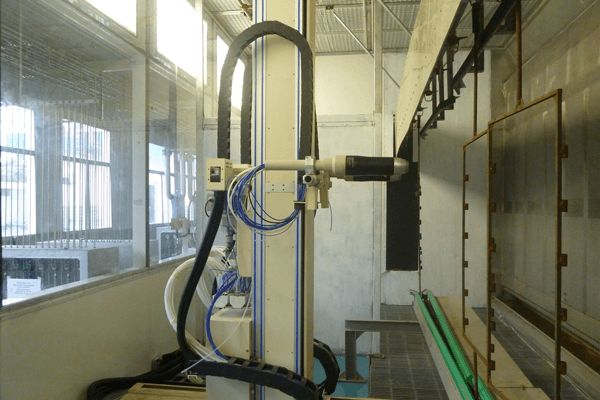
How manual batch powder coating booths compare against automated continuous conveyor lines: transfer efficiency, coating thickness tolerances, labor requirements, and how to evaluate plant records before investing.
Fundamental operating differences: batch manual vs continuous automated
The division between manual powder coating and an automated line is fundamentally an architectural one. In a manual batch installation, parts are hung onto wheeled metal trolleys or stationary racks. One or two operators manually spray each component using handheld electrostatic guns, after which the entire rack is manually pushed into a box oven for baking.
This batch methodology introduces inherent stop-and-go bottlenecks. Every time the batch oven doors open to load or unload a trolley, massive thermal energy vents directly onto the plant floor, cooling the chamber. The spray operators cannot spray while loading ovens or moving racks, capping overall factory utilization.
An automated line replaces intermittent batch handling with continuous overhead conveying. Components travel smoothly through chemical pretreatment, dry-off, automated reciprocator spray booths, curing tunnel, and cooling vestibules without touching the plant floor. The process moves from variable human tempo to precise mechanical cycle times.
- Manual systems rely on batch racks and intermittent box oven baking cycles
- Batch oven door opening vents substantial thermal energy into the factory
- Automated lines maintain steady continuous flow on overhead conveyors
- Eliminates staging bottlenecks and parts waiting on trolleys across the shop floor
Transfer efficiency and film thickness control across production shifts
In manual spraying, coating thickness is entirely dependent on operator wrist technique, gun-to-part distance, and mental focus. A rested operator at seven in the morning applies powder with reasonable consistency. By mid-afternoon, physical fatigue sets in; the operator naturally holds the gun closer to the workpiece and lingers longer over flat faces.
This operator fatigue produces wide film thickness variance across the same part — often reading forty to fifty microns on difficult internal corners while exceeding one hundred twenty microns on flat outer surfaces. Because powder is billed by weight, applying sixty microns where forty is required represents invisible, unrecoverable material cost.
Automated reciprocators eliminate human variance. Vertical reciprocator axes maintain constant programmed speeds and stroke lengths, while digital controllers regulate electrostatic voltage and current within precise parameters. Film build across continuous production runs stabilizes within tight tolerances, directly lowering raw powder consumption per coated square meter.
Throughput capacity: when part volumes exceed manual booth limits
Determining when to transition from manual booths to an automated line is primarily driven by daily surface area requirements. A skilled manual operator in a batch booth typically covers fifteen to thirty square meters of surface area per hour, accounting for part handling, spraying, and rack repositioning.
When a manufacturing plant's daily volume demands exceed four hundred to five hundred square meters, adding more manual booths creates diminishing returns. Each additional manual booth demands more plant floor space, more operators, additional batch ovens, and generates excessive staging buffers of parts waiting for baking.
A continuous automated line can effortlessly process eighty to over three hundred square meters per hour by optimizing conveyor line speed and part hanging density. Parts hung closely on custom hooks travel through the spray zone continuously, allowing a single automated line to replace four to six manual booths while occupying less floor space.
- Manual booth limit: typically 15 to 30 square meters per operator-hour
- Automation threshold: viable when daily production exceeds 400 to 500 square meters
- Custom multi-part jig hanging triples effective throughput on continuous conveyors
- Consolidates multiple scattered batch booths into one streamlined production cell
Color change agility and plant operational flexibility
A common misconception among factory managers is that automated lines lack flexibility for color changes. In older steel cyclone systems, changing colors was indeed a laborious process that could take forty-five minutes to an hour, making batch manual booths preferable for custom job shops spraying ten colors a day.
Modern automated booth engineering has solved this challenge through composite plastic construction and fast-cleaning multi-cyclone recovery units. Plastic composite walls exhibit minimal electrostatic attraction, allowing automated wall-cleaning blow-off devices to purge the booth interior in minutes.
For plants running three to five primary colors in large batch campaigns, automated color changeover times of ten to fifteen minutes are now standard. Manual booths retain an advantage only when a plant sprays dozens of small custom colors consisting of only five or ten parts each, where mechanical conveyor setup would be impractical.
Evaluating investment feasibility from your own plant records
Deciding to invest in an automated powder coating line should never be based on generalized vendor claims or arbitrary percentage savings. The decision must be calculated directly from internal plant records.
Begin by reviewing five internal datasets: your monthly powder procurement invoices versus theoretical square meter coverage; your daily QC inspection reject logs showing touch-up and recoat percentages; payroll records detailing manual spray operator overtime; monthly gas or electric utility bills for batch ovens; and customer claims related to coating defects or transit damage.
By comparing the actual cost per coated part in your plant logs against the projected throughput and reduced material variance of an automated continuous line, the true amortization period becomes clear and mathematically grounded.
- Review powder consumption logs against engineering surface area calculations
- Audit daily QC reject and rework logs to quantify touch-up labor costs
- Tabulate paint shop shift wages, overtime, and turnover recruiting costs
- Measure batch oven utility bills per ton of metal processed
- Validate throughput feasibility using actual factory production schedules
Technical and Operational Comparison
A side-by-side technical evaluation of batch manual booths versus continuous automated conveyor lines across critical plant production metrics.
| Manual Batch System | Automated Conveyor Line | |
|---|---|---|
| Throughput Capacity (m²/hour) | 15 - 40 m²/hour, strictly bounded by operator fatigue and trolley cycle times | 80 - 350+ m²/hour, governed continuously by line conveyor speed and jig density |
| Film Thickness Tolerance | Wide variation (typically 50 to 120+ microns across a single part) | Tight consistency (typically controlled within 60 to 75 microns) |
| Operator Labor Requirements | High manual labor: spray operators, trolley movers, and batch oven loaders | Streamlined: loading/unloading personnel plus automation monitoring technicians |
| First-Pass Transfer Efficiency | Highly variable, fluctuating with operator wrist fatigue and spray distance | High and repeatable, maintained by constant reciprocator speed and distance |
| Color Changeover Time | 5 - 10 minutes (simple hopper vacuum and manual gun purge) | 10 - 15 minutes with automated plastic composite cyclone booth systems |
| Inter-Shift Quality Drift | Noticeable difference in finish and paint usage between morning and night shifts | Negligible variation: digital PLC recipe controls voltage, current, and powder output |
Plant Record Parameters for Investment Feasibility
The specific internal factory metrics plant managers must pull from internal records to calculate the economic tipping point for automation.
| Internal Plant Record Source | Operational Impact When Automating | |
|---|---|---|
| Powder Consumption per m² | Monthly warehouse material withdrawal logs and part surface area records | Eliminates heavy over-coating on easily accessible outer part faces |
| QC Defect and Rework Rate | Daily quality inspection logs, rejection reports, and strip-and-recoat records | Eliminates operator fatigue inconsistencies, light spots, and touch-up variations |
| Labor Wages and Overtime | Payroll records, shift rosters, and overtime expenditure in the paint shop | Shifts labor from repetitive spraying to high-throughput loading and quality checks |
| Oven Thermal Energy Cost | LPG, natural gas, or electricity invoices for batch oven heating cycles | Continuous tunnel ovens eliminate repeated heat loss from opening batch oven doors |
| Floor Space and WIP Buffer | Plant layout drawings and staging buffer areas for cooling trolleys | Continuous monorail overhead transit frees floor space and prevents part bumping |
Technical questions regarding manual vs automated powder coating
- When should an Indonesian plant transition from manual to automated powder coating?
- A plant should evaluate automation when daily production consistently exceeds 400 to 500 square meters, when reject rates from manual film variation become unacceptable to clients, or when manual batch booths physically clog the factory floor with parts waiting for ovens.
- Why does manual powder coating produce inconsistent film thickness?
- Manual spraying depends entirely on human posture, gun distance, and operator fatigue throughout an eight-hour shift. Operators naturally overspray flat areas while under-coating recessed corners, creating film thicknesses that range from 50 to 120+ microns on the same part.
- Can an automated powder coating line handle varied part geometries?
- Yes. Automated lines utilize optical light curtain sensors that detect incoming part height and profile, triggering guns dynamically. Reciprocators can be programmed with distinct stroke recipes, and complex internal pockets can have a single manual touch-up station integrated before the curing oven.
- How long does a color change take on an automated line?
- Modern plastic composite booths with multi-cyclone recovery achieve full color changeovers in 10 to 15 minutes. Older steel booths or cartridge systems require substantially longer cleaning times.
- Should a factory keep a manual booth after installing an automated line?
- Keeping one small manual booth is often recommended for sample trials, R&D testing, or very small custom batch orders that would be inefficient to load onto the continuous automated conveyor.
- What plant records are required before requesting an automated line proposal?
- You should prepare your maximum workpiece dimensions (length, width, height, weight), daily square meter targets, current monthly powder purchasing logs, and available factory floor dimensions and gas/electrical utility ratings.
Analyze your plant's coating data with our engineering team
Share your current production volumes and part drawings with PT Solusi Rekatama Makmur. Our technical team will evaluate your operational parameters and calculate line sizing requirements.