In-House Powder Coating System vs Job Shop Service: Decision Guide for Indonesian Manufacturers
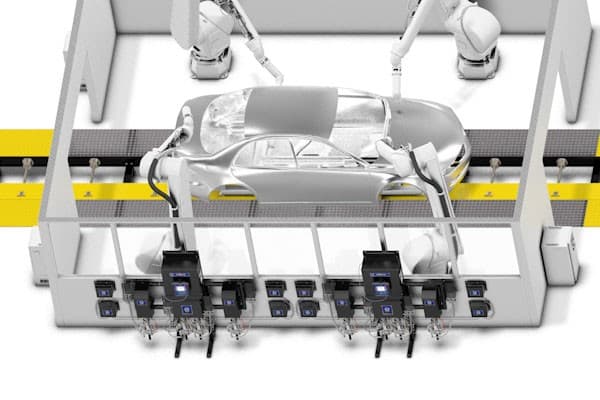
Clarifying our industrial role: PT Solusi Rekatama Makmur designs, builds, and integrates automated powder coating systems — we do not offer coating services. When should a manufacturing plant transition from external job shops to an in-house line?
Position clarifier: We engineer coating systems, we do not coat parts
Before examining the strategic economics of industrial finishing, an explicit distinction regarding our business role must be stated clearly: PT Solusi Rekatama Makmur is an industrial system integrator and authorized equipment distributor. We design, engineer, install, and commission automated powder coating lines, paint circulation systems, and industrial robotics. We are NOT a commercial job shop, and we DO NOT provide subcontracted coating or painting services for parts.
If your enterprise requires an external vendor to coat twenty metal brackets or spray custom consumer goods on a fee-per-piece basis, you require a commercial coating job shop. However, if your manufacturing plant produces metal components in volume and is evaluating whether to establish your own turnkey automated powder coating line, PT Solusi Rekatama Makmur is your engineering and technology partner.
Understanding this boundary is vital for factory managers. Making the leap from outsourcing coating to operating an internal continuous line represents a strategic operational transformation that eliminates outside dependencies and stabilizes product quality.
- PT Solusi Rekatama Makmur supplies and integrates industrial equipment and complete lines
- We do not provide third-party commercial coating, painting, or job-shop services
- Our engineering team helps manufacturing plants transition from outsourcing to in-house production
- Turnkey execution: pretreatment, booth, recovery, curing ovens, conveyors, and automation
When outsourcing to an external job shop remains the right choice
Subcontracting powder coating to an external commercial job shop is entirely logical under specific manufacturing circumstances. For young fabrication workshops, early-stage product startups, or businesses producing less than one hundred to two hundred square meters of coated metal per month, investing in an automated line is financially premature.
Job shops are also ideal for plants with erratic, seasonal production where coating volume spikes for two months and sits dormant for five. In such cases, paying an external vendor per square meter or per kilogram converts fixed overhead into variable operational expense.
Furthermore, if a business operates within a rented commercial building with strict zoning limits that prohibit industrial gas burners, high-amperage electrical connections, or industrial chemical wastewater handling (IPAL), outsourcing remains the only practical avenue until a dedicated industrial facility is established.
The volume tipping point: calculating subcontracting spend against line CAPEX
The decision to bring powder coating in-house is fundamentally governed by a volume tipping point. When a manufacturer's monthly payments to external coating job shops — combined with trucking freight and packaging expenses — reach significant recurring sums, outsourcing becomes an active drain on plant profitability.
Calculate your true annual outsourcing expenditure: tabulate twelve months of subcontractor coating invoices; add dedicated flatbed truck transportation costs between your plant and the coater's workshop; add wrapping materials and packaging labor required to protect bare and finished metal; and add the cost of scrapped components damaged during transport.
When this total expenditure is compared against the capital amortization, raw powder purchasing, utility costs, and operator wages of an in-house continuous line, the break-even threshold typically sits between three hundred and five hundred square meters of coated surface area per working day.
- Tabulate all 12-month subcontractor coating invoices across all product lines
- Add ongoing truck freight, driver wages, and toll road expenses between facilities
- Include protective foam wrapping, plastic sheeting, and packaging labor costs
- Financial tipping point typically occurs between 300 and 500 m² of daily production
Quality control, micron consistency, and salt spray certification
Cost is rarely the sole driver that prompts Indonesian manufacturers to invest in an in-house line; quality control and reject traceability are often the decisive factors. Commercial job shops survive on volume and routinely mix workpieces from five different clients into a single chemical dip tank.
This communal processing results in chemical bath contamination, inadequate oil degreasing, and inconsistent conversion coatings. When your automotive Tier-1 or multinational appliance customer demands certified five-hundred-hour or one-thousand-hour salt spray corrosion test reports, external job shops rarely provide verifiable chemical batch logs.
Furthermore, manual sprayers in commercial job shops rarely maintain consistent film build. One batch arrives at fifty microns with bare edges, while the next batch arrives at one hundred forty microns with heavy orange peel and clogged tapped screw holes. An in-house automated line with Electron equipment gives your quality assurance team one hundred percent control over chemical titration, electrostatic parameters, and curing temperature profiles.
Eliminating lead time delays and freight transit damage
In modern lean manufacturing and Just-In-Time (JIT) production, lead time predictability is paramount. Outsourcing powder coating introduces a minimum three to seven-day buffer into your manufacturing cycle. Your components sit on shipping docks, wait in queue at the job shop behind other clients' jobs, wait for batch oven consolidation, and wait for return transport.
Transit damage represents an ongoing source of friction and unrecoverable loss. Freshly coated sheet metal panels, electrical enclosures, and architectural profiles are highly susceptible to corner denting, vibration rub marks, and surface scratching when stacked on trucks navigating congested industrial roads.
Bringing the coating process in-house transforms your production flow. Fabricated components coming off punching and bending machines are immediately loaded onto the overhead conveyor, passing through pretreatment, coating, and curing to emerge finished and inspection-ready within sixty to ninety minutes.
- Eliminates 3 to 7 days of external queuing and transportation transit lag
- Enables true Just-In-Time manufacturing directly from fabrication to packaging
- Completely eliminates truck transit scratches, rub marks, and corner impact dents
- Protects intellectual property and proprietary product designs from public exposure
Facility readiness: floor space, electrical power, gas, and wastewater
Before purchasing an automated powder coating system, a plant manager must verify facility infrastructure readiness. An automated line is an industrial installation that requires four primary plant utilities.
Floor space: A compact automated line typically requires four hundred to eight hundred square meters with a minimum ceiling height of four point five meters to accommodate overhead conveyor drops and oven elevations. Layouts can be configured in linear, U-shape, or loop patterns to conform to factory column spacing.
Utilities: The plant must have sufficient electrical power (typically 40 to 80 kVA for conveyor drives, exhaust blowers, and controls), an industrial gas supply header (LPG bulk tank or pipeline CNG) with safety regulator stations, clean dry compressed air (filtered to 0.01 micron and dried to -40°C dew point), and an industrial chemical wastewater treatment plant (IPAL) to neutralize and filter pretreatment rinse effluent before discharge.
- Floor area: 400 to 800 m² with clear ceiling height of 4.5 to 6 meters
- Electrical power: 40 to 80 kVA 3-phase supply for motors, blowers, and automation
- Combustion fuel: bulk LPG storage or industrial pipeline natural gas (CNG)
- Compressed air: clean, dry, oil-free instrument air with refrigeration dryer
- Environmental compliance: industrial wastewater treatment (IPAL) for rinse effluent
In-House Automated System vs Outsourced Job Shop Service
A strategic evaluation framework comparing in-house capital line investment against long-term subcontracting to external powder coating job shops.
| In-House Automated Line | Subcontracted Job Shop Service | |
|---|---|---|
| Production Volume Suitability | Highly cost-effective for continuous, medium-to-large daily production (over 300–500 m²/day) | Practical for small, sporadic, low-volume, or highly irregular prototype batches |
| Quality Control & Micron Traceability | Full internal control: automated chemical titration, tight 60–75 micron tolerance, and certified salt spray compliance | Variable quality: parts often mixed with diverse metals in job shop baths; inconsistent film thickness |
| Production Lead Time & Agility | Instant turnaround: fabricated parts move immediately to the coating line within the same facility | 3 to 7 days delay: queuing at the vendor facility, waiting for color change batches, and return shipping |
| Logistics Costs & Transit Risk | Zero transport cost; zero risk of scratching, bending, or denting finished surfaces during truck transit | High ongoing truck freight, extensive protective wrapping costs, and frequent transit damage disputes |
| Capital Expenditure (CAPEX) Required | Requires upfront capital investment for machinery, ventilation, and utility hookups | Zero equipment capital investment; operational expense paid per piece or per kilogram |
| Factory Floor Space & Utilities | Requires dedicated factory floor space (typically 400–800 m²), electrical power, and gas supply | Zero factory space footprint required inside your own manufacturing premises |
| Proprietary Design Confidentiality | Proprietary metal designs and prototypes stay secure inside your own plant walls | Prototypes and fabrication drawings exposed to third-party vendor workshops and competitors |
Questions regarding in-house powder coating systems vs job shop services
- Does PT Solusi Rekatama Makmur provide powder coating subcontracting services for parts?
- No. PT Solusi Rekatama Makmur is strictly an industrial equipment supplier and turnkey system integrator. We design, manufacture, install, and commission automated powder coating lines and equipment for industrial factories; we do not offer commercial job-shop coating services.
- What minimum daily production volume justifies investing in an in-house automated line?
- Typically, when daily production consistently exceeds 300 to 500 square meters, or when monthly subcontractor invoices and freight exceed the amortization cost of equipment, bringing powder coating in-house becomes highly profitable.
- What are the primary quality risks when outsourcing to external coating job shops?
- The main risks are inconsistent film thickness (varying from 50 to 140+ microns), chemical bath cross-contamination from mixed customer parts, lack of certified salt spray testing records, and surface transit damage during truck freight.
- How long does it take to design, manufacture, and install an in-house automated line?
- A complete automated powder coating line typically requires three to five months from initial engineering approval through equipment fabrication, shipping, on-site installation, and final production commissioning.
- Do our factory operators require specialized technical skills to run an automated line?
- No prior automation background is required. PT Solusi Rekatama Makmur provides structured on-site training covering PLC operation, powder feed adjustments, routine cleaning, and preventative maintenance checklists for your team.
- How does PT Solusi Rekatama Makmur assist plants transitioning from job shops to in-house lines?
- We provide complete engineering consulting: analyzing your part drawings, calculating line sizing and throughput, conducting test spraying at our MM2100 demo lab, designing factory layouts, and executing turnkey commissioning.
Evaluate an in-house powder coating line for your manufacturing plant
Speak with our engineering team at PT Solusi Rekatama Makmur to assess your daily production volume, calculate line sizing, and determine the feasibility of establishing your own in-house finishing facility.